|
1
|
- Scott S. Emerson, M.D., Ph.D.
- Professor of Biostatistics,
- University of Washington
- May 1, 2004
|
|
2
|
|
|
3
|
- "Because the simplest thing
statisticians
- need to do is compare two
groups.
- And we don't know how to
do it."
- Attributed to Fred Mosteller when asked by Dr. Elliot Antman (a well
known cardiologist) to explain why we need so many types of two sample
comparison procedures.
|
|
4
|
- Most commonly used methods
- Parametric
- Accelerated failure time regression models
- Semiparametric
- Proportional hazards regression models
- Nonparametric
- Kaplan-Meier curves
- Weighted logrank statistics
|
|
5
|
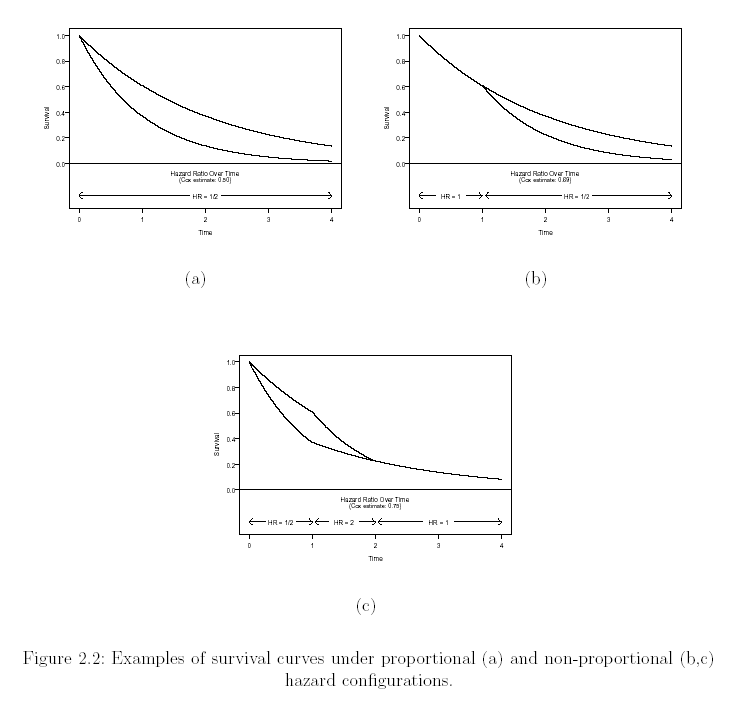
- Generalization of statistics derived from the proportional hazards
setting
- Particularly of interest in the setting of nonproportional hazards
- Early, transient treatment effects
- Late treatment effects occurring after some delay
|
|
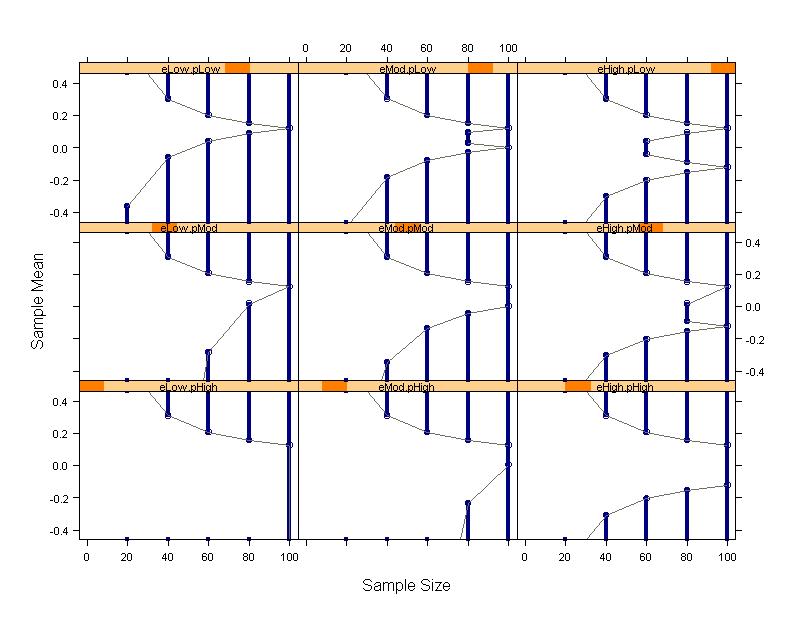
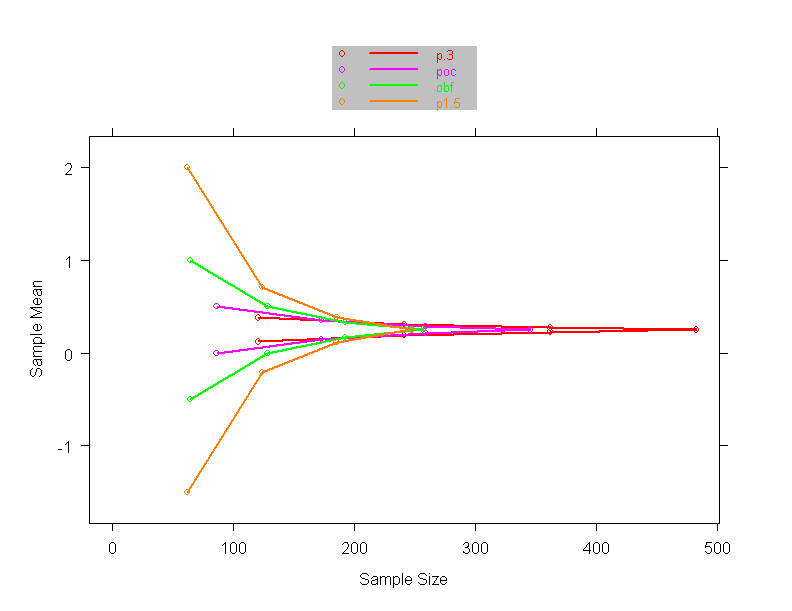
6
|
|
|
7
|
|
|
8
|
- Originally described as a straightforward approach to the presence of
censoring
- If we had followed all subjects a fixed amount of time, we could use
binomial proportions or odds
- Time is merely a confounder and/or precision variable in the analysis
of the probability of failure
- Adjust for time by stratification (dummy variables)
|
|
9
|
- Analysis of stratified 2x2 contingency tables
- Mantel-Haenszel statistic
- Noninformative censoring allows the repeated use of the same people in
all of the strata
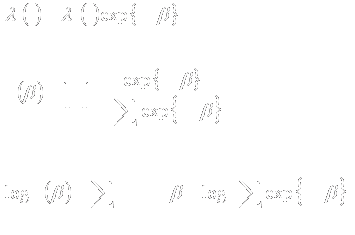
- Can also be derived as the score statistic from the proportional hazards
partial likelihood
|
|
10
|
|
|
11
|
|
|
12
|
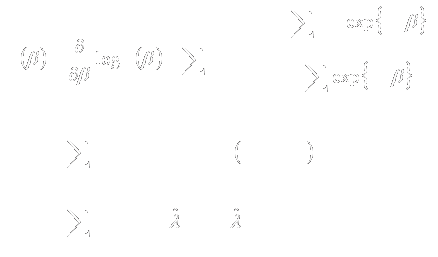
- Under proportional hazards, the efficient score statistic is a weighted
average of differences in hazards (proportions)
- Weights are roughly proportional to the size of the risk sets at each
failure time
- Intuitively reasonable if the treatment effect is constant over time
- Under time-varying treatment effects, we might want to weight more
heavily the times with a difference in hazards
|
|
13
|
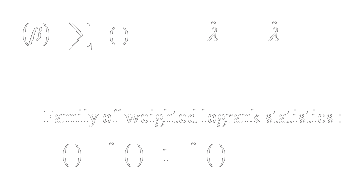
- Choose additional weights to detect anticipated effects
|
|
14
|
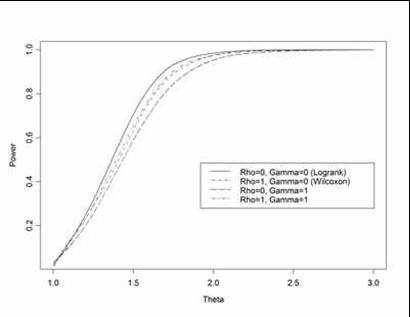
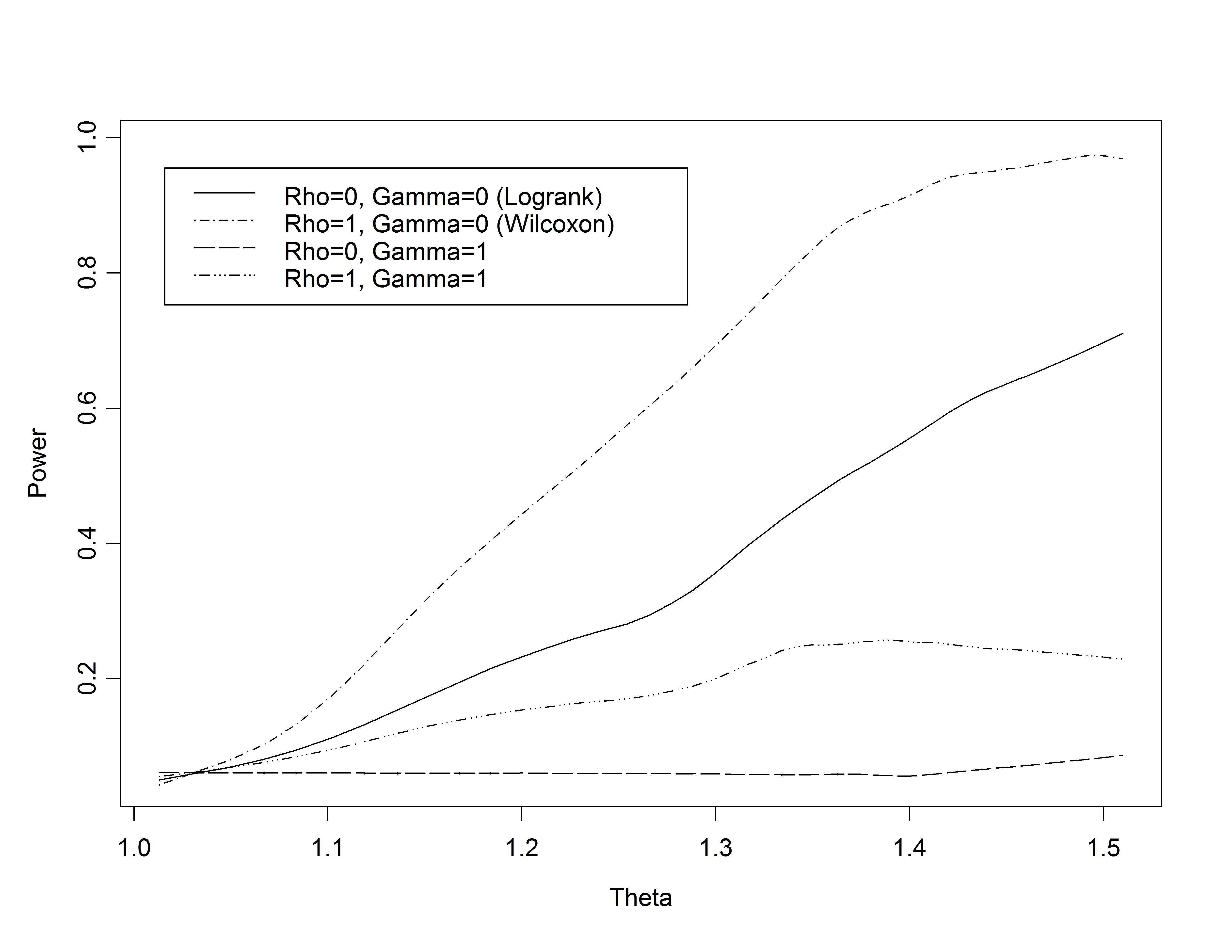
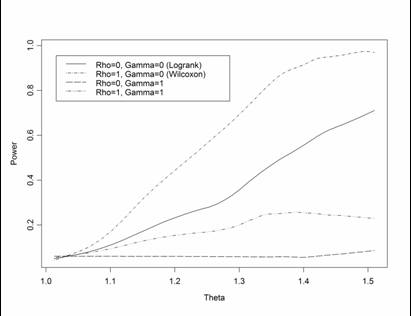
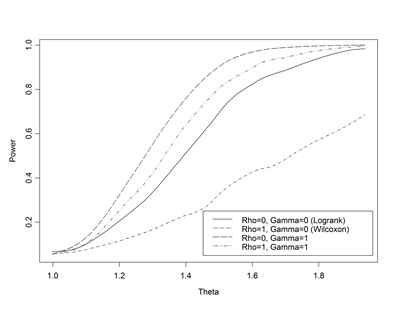
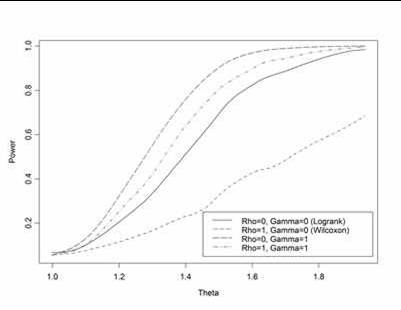
- Fleming & Harrington:
- Logrank statistic: ρ=0; γ=0
- Wilcoxon statistic: ρ=1; γ=0
- Weights early differences more heavily
- “Early” defined relative to survivor function, not time
- ρ=1; γ=1
- Places greatest weight between 25th, 75th
quantiles
- ρ=0; γ=1
- Weights late differences more heavily
|
|
15
|
|
|
16
|
|
|
17
|
|
|
18
|
|
|
19
|
- The scientific interpretation of these weighted logrank statistics is
difficult in the presence of nonproportional hazards
- (And why use them when we have PH?)
- The weights we specify are only part of the story
- The size of the risk sets at each failure time also affects the
inference
|
|
20
|
- The size of the risk set is affected by
- The survivor function in each group
- Something we care about
- Something we hope is consistent across studies
- The censoring distribution in each group
- Something that we usually regard a matter of convenience
- Something that we hope will not affect the scientific estimates, just
the statistical precision
|
|
21
|
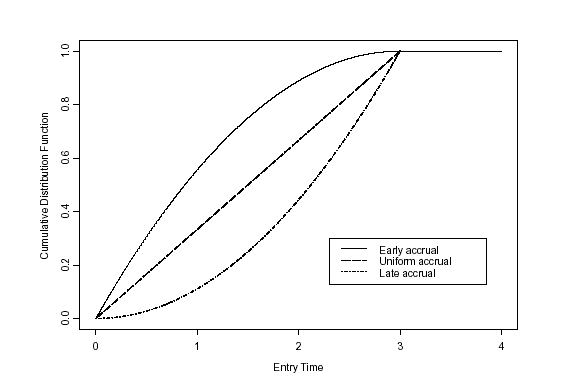
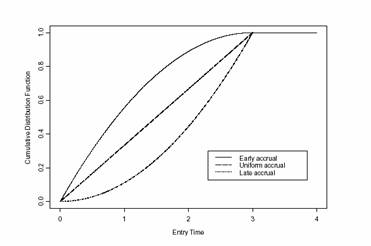
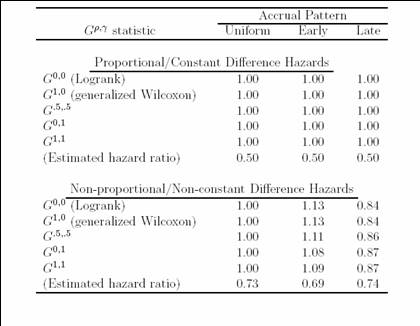
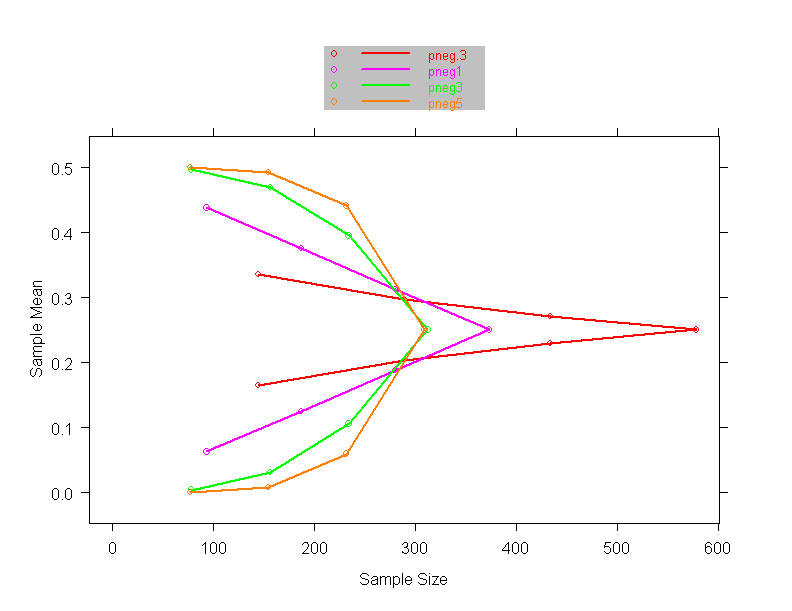
- Consider patterns of accrual that are either uniform, faster early, or
faster late
|
|
22
|
|
|
23
|
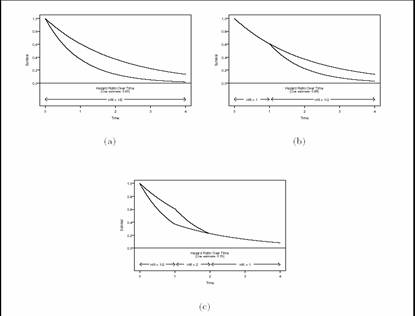
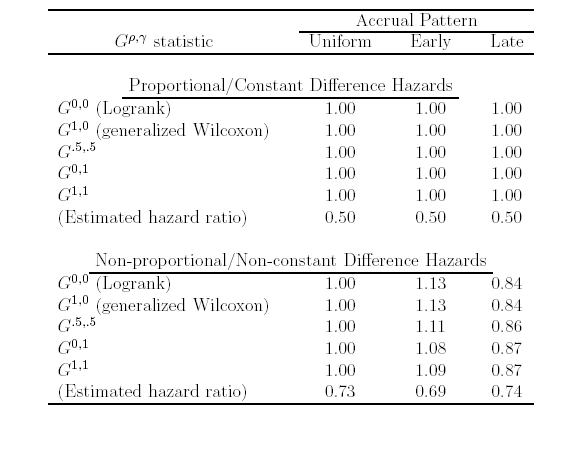
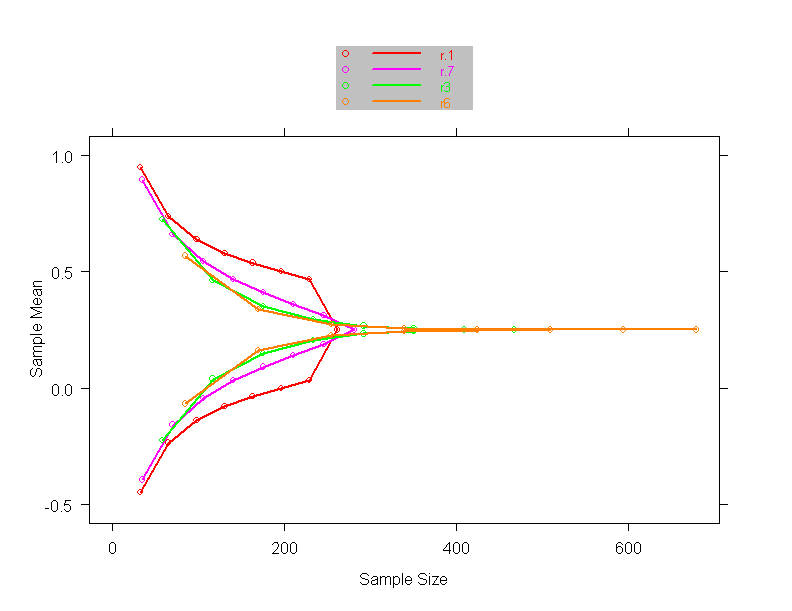
- The estimates of treatment benefit can vary even more markedly according
to the censoring distribution
- With “crossing hazards”, changes in censoring can make any of the
weighted logrank statistics qualitatively differ from each other
- And it is possible for the conclusion drawn from the statistic to
differ markedly from the conclusion suggested by the survival curves
|
|
24
|
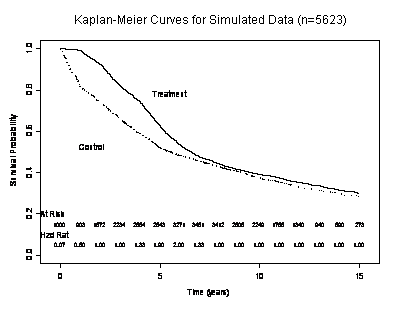
- Consider survival with a particular treatment used in renal dialysis
patients
- Extract data from registry of dialysis patients
- To ensure quality, only use data after 1995
- Incident cases in 1995: Follow-up 1995 – 2002 (8 years)
- Prevalent cases in 1995: Data from 1995 - 2002
- Incident in 1994: Information about 2nd – 9th
year
- Incident in 1993: Information about 3rd – 10th
year
- …
- Incident in 1988: Information about 8th – 15th
year
|
|
25
|
|
|
26
|
- Proportional hazards analysis estimates a Treatment : Control hazard
ratio of
- B: 1.13 (logrank P = .0018)
- The weighting using the risk sets made no scientific sense
- Statistical precision to estimate a meaningless quantity is meaningless
|
|
27
|
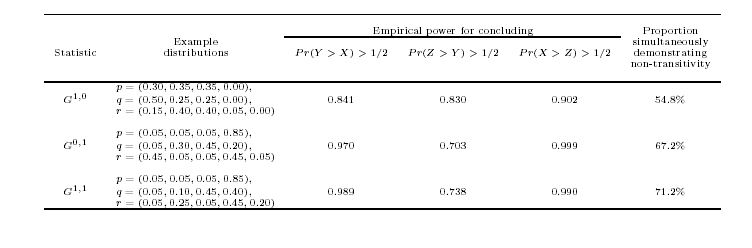
- The weighting scheme used in the weighted logrank statistics also
introduces intransitivity to studies
- The weights are stochastically determined from
- Each group’s survivor function
- The censoring distribution
- Hence we can obtain A > B > C > A
- Very distressing to regulatory agencies, if not all scientists
|
|
28
|
|
|
29
|
|
|
30
|
- Experimentation in human volunteers
- Efficacy: Can the treatment alter the disease process in a beneficial
way?
- Phase II (preliminary); Phase III
- Safety: Are there adverse effects that clearly outweigh any potential
benefit?
- Effectiveness: Would adoption of the treatment as a standard affect
morbidity / mortality in the population?
- Phase III (therapy); Phase IV (prevention)
|
|
31
|
|
|
32
|
- Ensure that the trial will satisfy the various collaborators as much as
possible
- Discriminate between relevant scientific hypotheses
- Scientific and statistical credibility
- Protect economic interests of sponsor
- Efficient designs; Economically important estimates
- Protect interests of patients on trial
- Stop if unsafe or unethical and when credible decision can be made
- Promote rapid discovery of new beneficial treatments
|
|
33
|
- At the end of the study
- Estimate of the treatment effect
- Single best estimate
- Precision of estimates
- Decision for or against hypotheses
- Binary decision
- Quantification of strength of evidence
|
|
34
|
- Ethical and efficiency concerns are addressed through sampling which
might allow early stopping
- During the conduct of the study, data are analyzed at periodic
intervals and reviewed by the DMC
- Using interim estimates of treatment effect
- Decide whether to continue the trial
- If continuing, decide on any modifications to sampling scheme
|
|
35
|
- Perform analyses at sample sizes N1. . . NJ
- Can be randomly determined
- At each analysis choose stopping boundaries
- Compute test statistic T(X1. . . XNJ)
- Stop if T < aj (extremely low)
- Stop if bj < T < cj (approximate equivalence)
- Stop if T > dj (extremely high)
- Otherwise continue (with possible adaptive modification of analysis
schedule, sample size, etc.)
|
|
36
|
- Issues when using a sequential sampling plan
- Design stage
- Boundaries to satisfy desired operating characteristics
- E.g., type I error, power, sample size requirements
- Monitoring stage
- Flexible implementation of the stopping rule to account for
assumptions made at design stage
- E.g., sample size adjustment to account for observed variance
- Analysis stage
- Providing inference based on true sampling distribution of test
statistics
|
|
37
|
- Alternative plans for a sepsis trial comparing 28 day mortality rates
with 90% power to detect a 7% improvement using N=1700
- Fixed sample study:
- Gather data on 1700 patients and analyze data
- Group sequential study (OBF efficacy, P=0.8 futility):
- Perform analysis after 425 patients
- If test statistic very low or very high, stop
- If test statistic intermediate, accrue another 425
- Repeat, as necessary, until maximum of 1700 patients
|
|
38
|
- Advantage of stopping rule:
- Fixed sample: 4.18%
improvement is significant
- Harmful: Power=
0.001; Average N= 1700
- No effect: Power=
0.025; Average N= 1700
- Low effect: Power=
0.500; Average N= 1700
- Beneficial: Power=
0.975; Average N= 1700
- Grp sequential: 4.24% improvement is significant
- Harmful: Power=
0.001; Average N= 785
- No effect: Power=
0.025; Average N= 987
- Low effect: Power=
0.477; Average N= 1330
- Beneficial: Power=
0.966; Average N= 1104
|
|
39
|
- Often, the criteria for judging statistical evidence in clinical trial
results are based on frequentist criteria
- Experimentwise error probabilities
- Optimality of point estimates
- Computation of precision
|
|
40
|
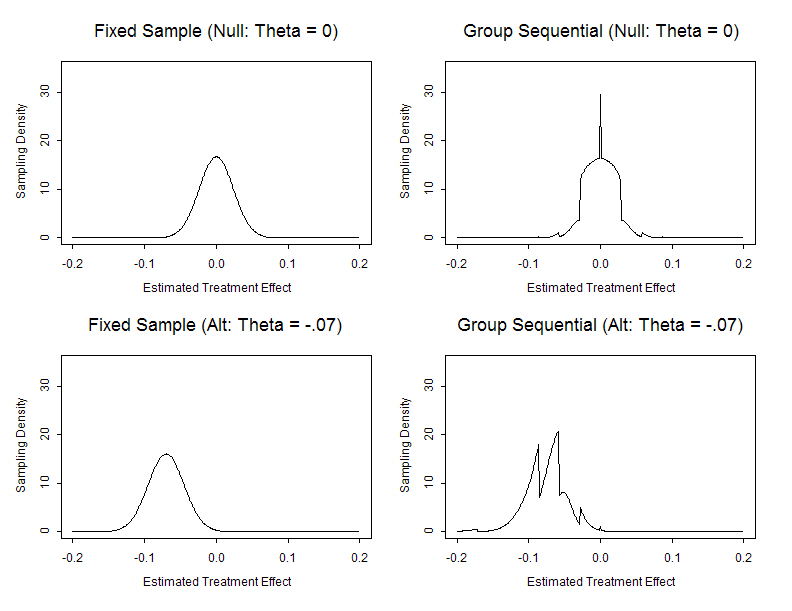
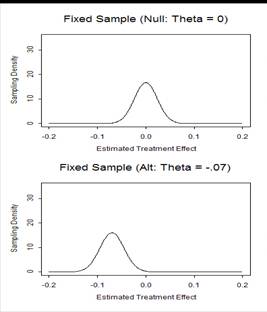
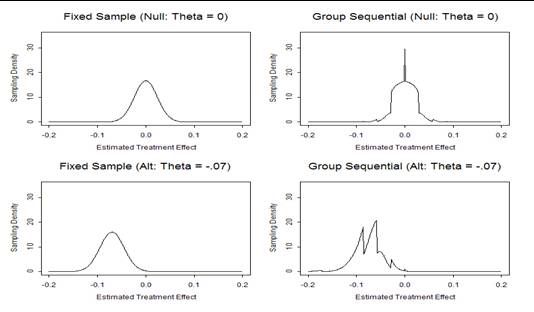
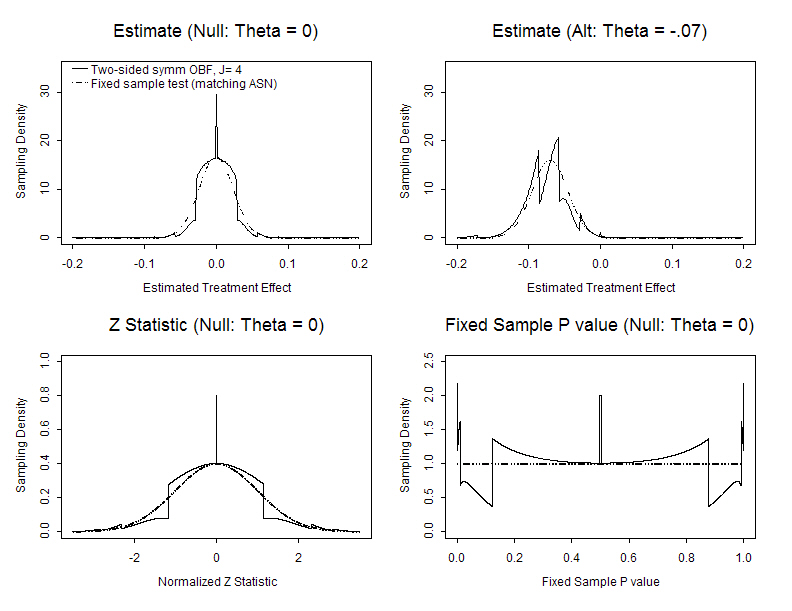
- Frequentist operating characteristics are based on the sampling
distribution
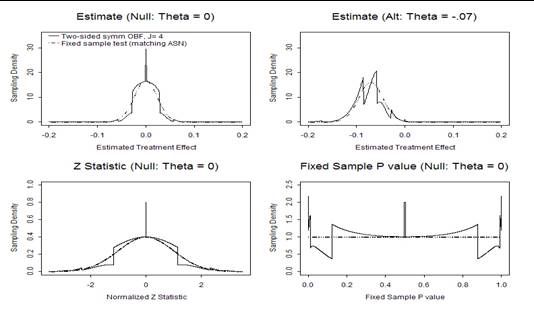
- Stopping rules do affect the sampling distribution of the usual
statistics
- MLEs are not normally distributed
- Z scores are not standard normal under the null
- The null distribution of fixed sample P values is not uniform
- (They are not true P values)
|
|
41
|
|
|
42
|
|
|
43
|
|
|
44
|
- For any stopping rule, however, we can compute the correct sampling
distribution with specialized software
- From the computed sampling distributions we then compute
- Bias adjusted estimates
- Correct (adjusted) confidence intervals
- Correct (adjusted) P values
- Candidate designs can then be compared with respect to their operating
characteristics
|
|
45
|
- Various test statistics are transformations
- A stopping rule for one test statistic is easily transformed to a rule
for another statistic
- “Group sequential stopping rules”
- Sum of observations
- Point estimate of treatment effect
- Normalized (Z) statistic
- Fixed sample P value
- Error spending function
- Conditional probability
- Predictive probability
- Bayesian posterior probability
|
|
46
|
- Boundary shape function unifies families of stopping rules
- Wang & Tsiatis (1987) based families
- O’Brien & Fleming (1979); Pocock (1977)
- Also used by Emerson & Fleming (1989); Pampallona & Tsiatis
(1994)
- Triangular test (Whitehead, 1983)
- Seq cond probability ratio test (Xiong & Tan, 1994)
- Conditional or predictive power
- Peto-Haybittle (using Burington & Emerson, 2003)
|
|
47
|
- Down columns: Early vs no early stopping
- Across rows: One-sided vs two-sided
|
|
48
|
- A wide variety of boundary shapes possible
- All of the rules depicted have the same type I error and power to
detect the alternative
|
|
49
|
- Process of choosing a trial design
- Define candidate design
- Usually constrain two operating characteristics
- Type I error, power at design alternative
- Type I error, maximal sample size
- Evaluate other operating characteristics
- Different criteria of interest to different investigators
- Modify design
- Iterate
|
|
50
|
- Generally the same for all stopping rule s
- Frequentist power curve
- Type I error (null) and power (design alternative)
- Sample size requirements
- Maximum, average, median, other quantiles
- Stopping probabilities
- Inference at study termination (at each boundary)
- Frequentist inference
- Bayesian inference under spectrum of priors
- Futility measures
- Conditional power, predictive power
|
|
51
|
- Time Varying Treatment
- Effects
|
|
52
|
- The design, monitoring, and analysis of sequential trials is fairly well
established for treatment effects that do not vary over time
- Means
- Proportions
- Odds
- Proportional hazards
|
|
53
|
- With nonproportional hazards, new issues must be addressed
- Choice of summary measure
- Handling any dependence on the censoring distribution
- Definition of alternative
- Computation of operating characteristics
- Flexible implementation
|
|
54
|
- A summary measure that depends on the censoring distribution is the
biggest problem
- In a survival study, we typically have a different censoring
distribution at successive analyses
- Hence, different summary measures are being tested at different
analyses
|
|
55
|
- This is particularly true with weighted logrank statistics
- At the final analysis, weights will be applied over a wider range of
time than is possible at earlier analyses
- At the earlier analyses, early results are weighted more heavily than
they will be later
|
|
56
|
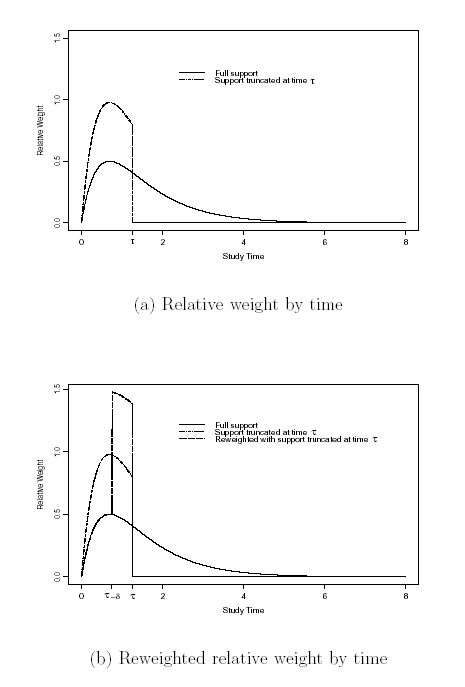
- A 7 year trial is planned using a weighted logrank statistic to place
weight late
- Plan:
- 1/28, 2/28, 3/28, …, 7/28 weight over the 7 years
- An interim analysis conducted after 3 years
- 1/6, 2/6, 3/6 over the first three years
- (later years have no data, hence no weights)
|
|
57
|
- Apply weights due to be used late in study to the most longterm
experience
- In the example, we would apply weights
- Tends to (appropriately) inflate variability of statistic at interim
analyses
- Intuitively reasonable in that the results for the longest observations
should be more indicative of the future
- Similar to imputing future observations
|
|
58
|
|
|
59
|
|
|
60
|
- Analysis at the end of the trial must take into account the sampling
plan
- Methods for confidence intervals involve defining an “ordering of the
sample space”
- Must decide how to order results obtained at different stopping times
- Previously described methods
- Analysis time or stagewise ordering
- MLE ordering
- Z statistic ordering
|
|
61
|
- There is no single best ordering
- Whitehead and Jennison & Turnbull prefer the analysis time ordering
- In the presence of time invariant treatment effects, it does not
usually make too much of a difference
|
|
62
|
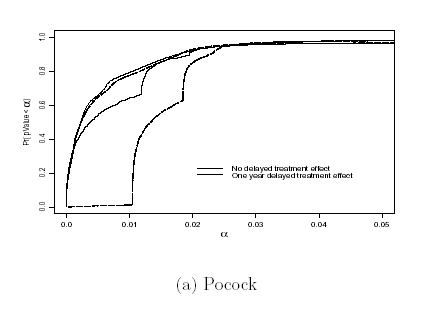
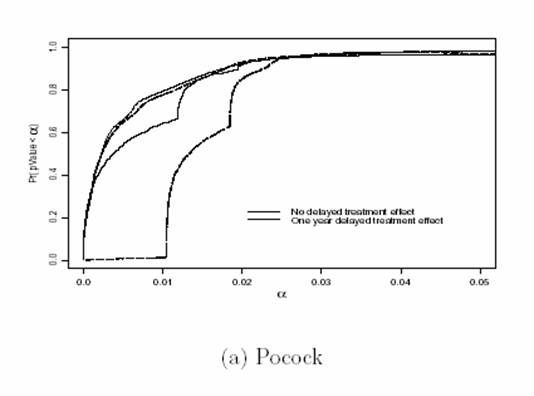
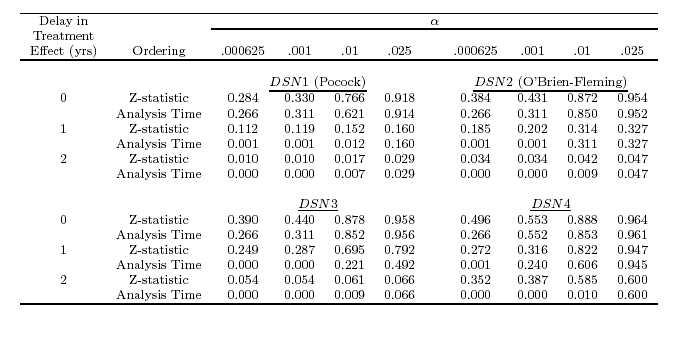
- However, the analysis time ordering corresponds to the error spending
function
- You can never get a P value less than the error spent
- This means that with late onset treatment effects, you can not achieve
as low P values as might otherwise be indicated
- Great impact on “pivotal trials”
|
|
63
|
|
|
64
|
|
|
65
|
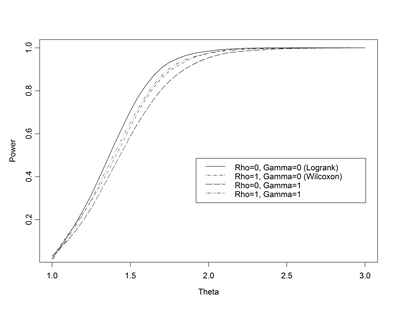
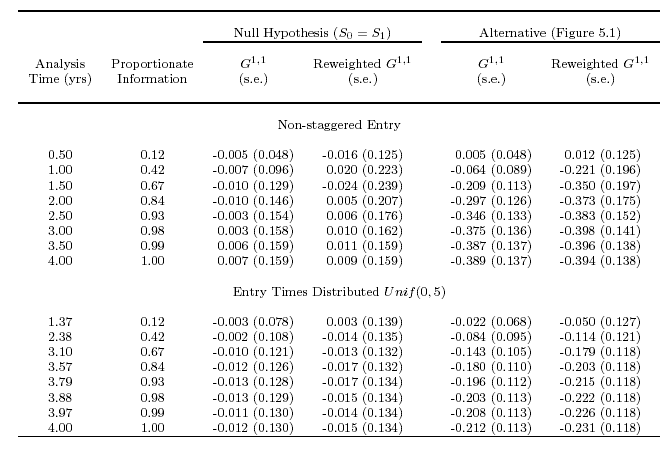
- We have found that our first attempts at improving the scientific use of
the weighted logrank statistics has worked well
- Greatly improved consistent estimation
- Minimal loss of power
|
|
66
|
- Much more work is needed when using sequential methods with time varying
treatment effects
- We are exploring the use of Bayesian random walk processes to model the
types of alternatives that might be addressed
- However, this is truly an insoluble problem:
- There is nothing in the data that can guarantee what future data might
look like
|
|
67
|
- In any case, however, the issue of paramount importance is that
decisions about the summary measure be driven by the scientifically
important effects
- Censored survival data requires a bit of extra care
- But the scientific issues are the same
|

 Notes
Notes